
Turning Scores Into Growth: How to Talk to Students About Lexile & Quantile Measures
- College and Careers
- Quantile
- Lexile



At some point every school year, students come face to face with these numbers: a Lexile measure, a Quantile measure, a spot on a percentile chart. How that moment goes, whether it builds a student up or shuts them down, has almost nothing to do with the number itself and everything to do with how we talk about it.
That's why, anytime Lexile and Quantile measures are part of a lesson, there's one non-negotiable goal: Students leave feeling informed and motivated, never labeled or discouraged.
Numbers Can Be a Verdict, or They Can Be a Map
Lexile and Quantile measures, grade-level percentile charts, and career entry-level targets can all, if handled carelessly, feel like a verdict on a student's worth. Handled well, they become a map for growth.
The difference isn't the data. It's the framing around it and that framing has to be intentional, consistent, and repeated. A single well-meaning sentence at the start of class won't undo the sting of a number that feels lower than a student hoped.
Three Ideas That Should Run Through Every Conversation
No matter what grade level, subject, or moment you're in, these three ideas should be present every time Lexile and Quantile measures come up:
- Measures are a starting point, not an endpoint. A measure describes where a student is right now, not who they are or what they're capable of becoming.
- Growth is measured in a personal range, not against a classmate. Students compare this year's measure to their own last measure, never to the student next to them.
- Privacy protects honesty. Students are never asked to say their exact Lexile or Quantile number out loud to the class. That single norm does more to prevent shame than any script line can.
Growth-Mindset Moments: Where Discouragement Is Most Likely To Occur and What to Say
Some moments carry more risk than others. These are the points where a student is most likely to internalize a number as a judgment rather than information. This is where a short, deliberate reframe matters most.
🌱 When talking about growth in general. Before students think about their own number at all, set the expectation that growth is slow and steady, not instant:
"Nobody grows 300 points in one week. Growth happens in small, steady steps: a little more reading, a little more practice, year after year. If today's number isn't where you hoped, that's just today's starting line, not the finish line."
🌱 Right before students look up their own measure. This is the moment to protect privacy and reframe the number as useful information, not a report card:
"This is personal information like a step count on a fitness tracker, not a grade on your report card. You will not say your exact number out loud unless you choose to. If your number feels lower than you hoped, that's not a verdict. It's just where you're starting from today. It tells us exactly where to focus your growth, which is actually useful information to have."
🌱 When using a percentile chart. Make growth concrete by doing the math out loud instead of leaving it abstract:
"Look at a grade-level chart, 50th percentile column: Fall and Spring. That's about a 60-point climb over one whole school year, for a student who is already meeting grade-level norms. So, a 50-ish point move in a year is a completely normal, achievable target, not a leap."
Example:
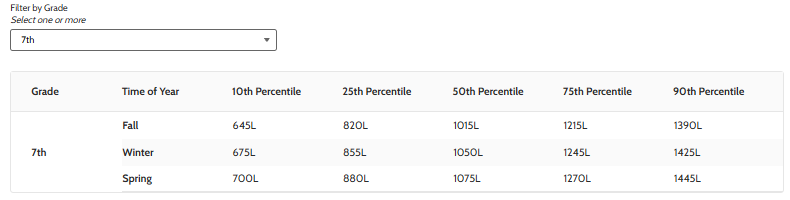
There is no single "finish line" box on any of these charts. Every column, including the 90th percentile, keeps climbing from Fall to Spring, because growth is the expectation for every student, not just some.
🌱 When introducing career entry-level measures. This is the highest-risk moment of all. Career targets sit well above where most students are right now and that's expected, not a problem. Say so explicitly, before students ever see the numbers:
"These numbers show the measures of ADULTS who are already working in these careers. These are people with 10, 15, even 20 more years of reading and practicing than you've had so far. Comparing your grade-level number to a working adult's number is like comparing your mile run time to an Olympic runner's. Nobody expects you to already be there. The point of this activity isn't 'how far away am I', it's 'I can see the path, and I know exactly what kind of growth gets me on it: read more, in my range, every year, and keep building math skills year over year.' Any one of these careers is reachable from wherever you're starting today."
Building Toward Real Ownership
When these ideas and reframes are used consistently, not as a one-time disclaimer, as the thread running through the whole conversation something shifts. Students stop experiencing their measure as something that happened to them and start treating it as something they understand and can act on.
That shift is exactly what the framework below captures: five connected pieces that build toward one outcome, Elevated Achievement.
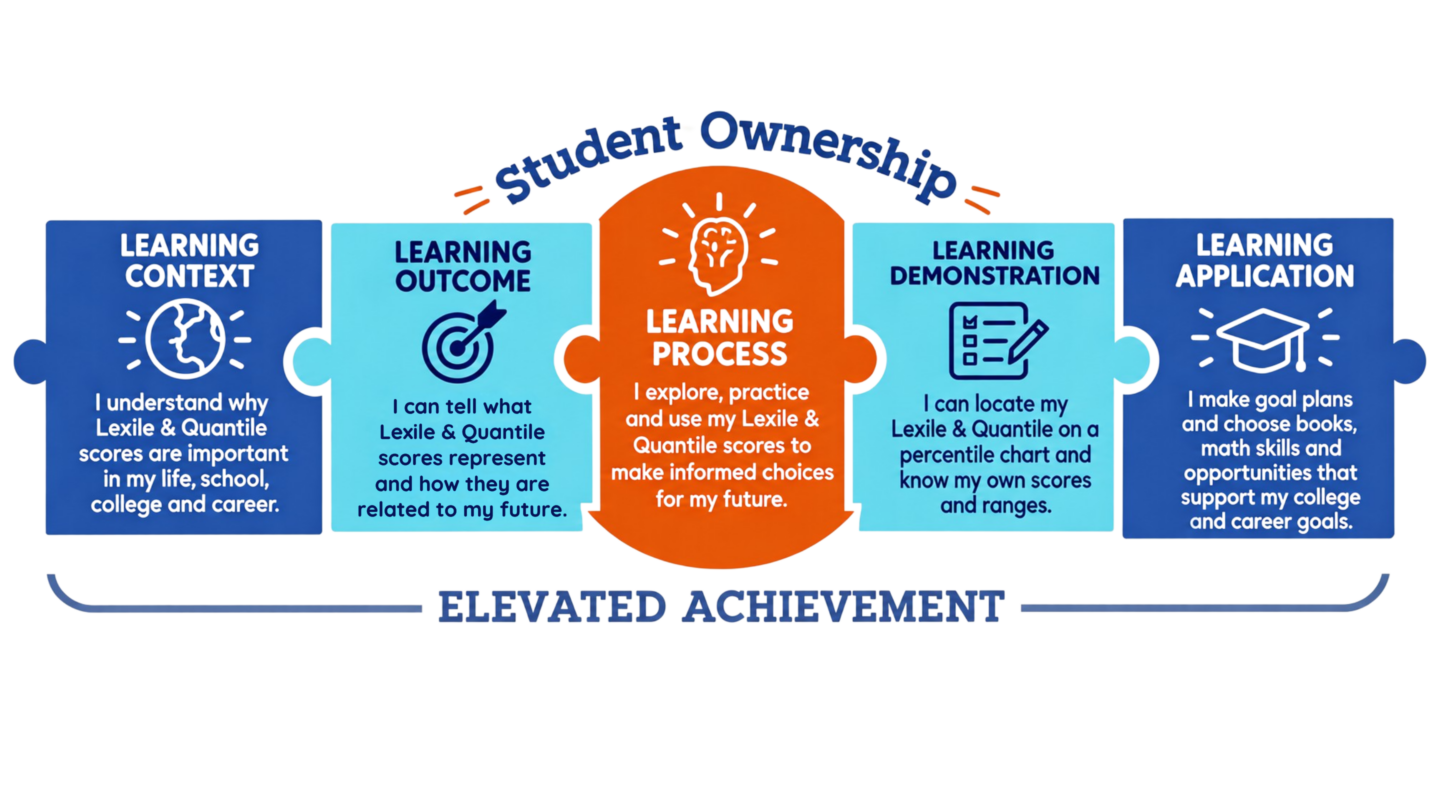
Note: The image above is adapted from the Elevated Achievement Group’s Learning Model
Notice where the Learning Process sits: right at the center. That's not incidental. It's the piece where students actually explore, practice, and use their measures, and it's exactly where the growth-mindset moments above do their work. Get that center piece right, and the rest of the framework holds together.
The Goal, Restated
A Lexile or Quantile number will never be neutral on its own. Students will read some meaning into it whether we guide that meaning or not. Our job, as educators, is to make sure the meaning they land on is the true one: that this number is a starting point, that growth is normal and expected, and that they are fully capable of moving it. Say it consistently enough, at every risk point, and students walk away not measured, but equipped.